Showing posts with label Dr. Dale Bredesen. Show all posts

Saturday, February 15, 2020

Hospitalization and Frailty

Maureen in the afternoon sun

Aside from the two times she gave birth, my mother has never had to stay in a hospital. She has had cataract surgery, Mohs surgery for skin cancers, and she has been treated in an emergency room and in an urgent care facility, but as of this week, she has never been hospitalized overnight for illness. Now that she has Alzheimer’s, I have dreaded the possibility of having to either call an ambulance, or admit her to a hospital, as I feared the resulting anxiety and disorientation would be more debilitating than whatever affliction might befall her. So last weekend when she began to have serious rectal bleeding, I made a round of phone calls and found that my anesthesia doctor from my recent ankle surgery was also practicing geriatric medicine and could do a house call that same afternoon. Imagine that! 

He immediately had me suspend four of her medications. Two were her Alzheimer’s medications, donepezil and memantine, here in Italy known as Aricept and Ebixa. For some time I had suspected they were doing more damage than good. In fact I recently read that memantine and donepezil should not be taken together, and not by patients with heart conditions. My mother has both high blood pressure and a heart arrhythmia. Donepezil is also bad for people with asthma, which my mother has had all her life. The other drug was warfarin, which thins the blood to presumably prevent strokes and heart attacks, but it carries a risky potential for causing internal bleeding. We agreed that hospitalization was not yet necessary, and might make matters worse for her. When her symptoms persisted the next day, he had her admitted to a private hospital not far from where we live.

Her hemoglobin was dangerously low, so she was given blood and plasma transfusions in order to prepare her for a diagnostic endoscopy and colonoscopy the following day. Thankfully with the help of some fantastic nurses, I got her through the prep and we had generally good news from the procedures: no tumors, no hemorrhoids, no need for any surgery. However, she had diverticulitis, and the working hypothesis was that her worsening anemia coupled with the impact of that cocktail of medications caused internal bleeding that eventually led to the hemorrhaging. Luckily a careful diet can help the intestinal healing, and now we will work to figure out how to improve her heart and lung health. 

I imagine readers of this blog are well aware of the dubious results of these two widely prescribed Alzheimer’s medications, and of the many undesirable side effects. Dr. Dale Bredesen whose work I have previously written about, posted on his Facebook page about a year ago about a meta analysis:
a recent study showed that patients treated with standard Alzheimer’s drugs donepezil (Aricept) or memantine (Namenda) actually declined more rapidly than those who were not treated with those drugs (Kennedy et al., JAMA Network Open. 2018;1(7):e184080. doi:10.1001/jamanetworkopen.2018.4080

What may be less understood by caretakers and even medical professionals is how the frailty of old age can mean unseen vulnerability that is not diagnosed with typical bloodwork and routine doctor visits. I think of myself as a pretty well-informed caretaker, someone who has done a lot of reading about Alzheimer’s, but I did not go to medical school, so I put a great deal of trust in doctors. When I saw symptoms like nighttime coughing, complaints of feeling cold, rising creatinine levels, increased sleepiness, breathlessness with fatigue, I did not pursue the possible reasons, even though I wondered about the medicines that negatively impacted kidney function. My mother’s doctor most recently diagnosed a flair up of asthma and prescribed prednisone, and it reassured me the chest x-ray showed no change from the previous one and therefore she felt the heart was not to blame for her symptoms. In retrospect, I am shocked that a simple online search turned up the fact that iron-deficiency anemia (which my mother has been taking iron supplements for since late fall) is almost always due to blood loss, and a simple test can determine if there is blood in the stomach or bowels. 

Lessons learned the hard way always leave a residue of guilt. I am grateful for the happy outcome of the procedure, for a trustworthy and competent doctor and his colleagues at the hospital, and for a mother who is a stubborn warrior and even in her most distressed state was willing to fight through it. I am more skeptical than before all this happened about the medical establishment, which seems even more dysfunctional than the really messed up field of education that has been my life's work. I see disturbing parallels. We know from replicable and reliable research that these medications are not working and are even dangerous, yet millions continue to take them in the hope they'll do something for their loved ones. We know that the toxic testing culture taking over educational settings is not improving learning outcomes and is actually harmful to students and teachers, yet we persist in ranking, sorting, praising and publicly humiliating people. We have a long way to go. We're not getting younger, and most of us are not getting healthier. Or for that matter, smarter. 

Saturday, April 13, 2019

Thinking About Health


Seven years ago today I was released from the hospital after a three-week stay. If you have ever been in the hospital, you know that is a long time. I had perforated my appendix while in Italy but thought I had a bad stomach flu. I miraculously flew home, stayed in bed for a day, and then was so ill I had to be taken to the hospital in an ambulance. I was in full sepsis, kidney failure, the works. Antibiotics saved my life, plus an awesome team of nurses and doctors (in that order). This experience changed my life. I am certain that is true for anyone who fought a serious illness, or who continues to battle diseases both visible and invisible. Now that I am a full time caretaker for my mother and have been doing research on Alzheimer’s, I have a few thoughts to share on this anniversary.


Doctors can only do so much
Medical training is rigorous, competitive, and not for the faint of heart. It requires massive amounts of memorization, ongoing test taking and certification, long hours of practical experience which involves extended sleep deprivation, and undoubtedly causes considerable stress. Doctors have to make life and death decisions, sometimes in a moment of crisis, sometimes after careful research and consideration of all options. They make mistakes, and while most of us can agree that learning from mistakes is a part of life, for doctors, they may come with the burden of guilt, of fear, even sorrow.

These demands have led to extreme specialization, so it is increasingly rare to find an internist or general practitioner who has the knowledge and experience to see the big picture of a patient’s health, regardless of age, gender, and medical history. You see more and more that doctors will tell patients they must see yet another specialist. Each of these specialists is trained to prescribe medication, sometimes on a short term basis, but more often indefinitely. Having read the fine print on many types of prescription medications, I am willing to bet that most specialists cannot remember drug interactions except for common ones, and so they rely on computer programs to cross-check, but computer programs are not infallible, nor do they necessarily keep up with the latest research, which in turn can’t keep up with extant empirical evidence. Plus most side effects do not affect all patients in the same way. That’s why drug commercials have to say all the potential side effects as quickly as possible, to make us believe that those bad things won’t happen to us if we take the medicine.

When medicine can’t cure what ails us, doctors prescribe surgery. Surgeons can do amazing things, sometimes without having to cut open our bodies. My four hour surgery to clean up the mess of my perforated appendix (and remove my gallbladder) was done through a single incision in my belly button. I have no scars to show for my ordeal. All my scars are internal. That’s right, sepsis leaves a trail of adhesions throughout the abdomen, and even laparoscopic surgery causes scar tissue to form internally. Did anyone explain this to me? Of course not. I had to ask my surgeon about symptoms before finding out this lasting side effect, and on my own, had to learn about massage and exercise that keeps me from having any intestinal blockages and keeps my organs from getting stuck in scar tissue. My surgeon did tell me that unfortunately more surgery means more adhesions.

Now sometimes doctors need the help of psychologists to diagnose illness. In the case of various forms of dementia, neurologists usually have some simple-to-administer surveys and tasks that can assist in early diagnosis. In my mother’s case, this survey was farmed out to a young office assistant. My mother, insulted by the simplicity of the questions and the age of the young girl trying to figure out if she was having comprehension problems (which she was probably quite aware of and had been trying to hide and compensate for them for some time), refused to complete the test. I had to sympathize. What was the neurologist thinking? That he didn’t have the time or inclination to do those surveys with elder patients. But was he aware of how easily that eroded the patient-doctor trust that was the basis for his practice? Similarly I learned more about my heart and high cholesterol from the technician doing my exams than from my primary care doctor.

Nutrition is the first line of defense against disease
You are what you eat, how many times have we heard that advice and ignored it? Now the diet fads have cool-sounding labels like keto and paleo, and for those who need their healthy “food” on the go, we have $12 juice drinks made to order if you live in an urban environment where there are enough paying customers to keep such a place in business. Even though there is growing consensus that sugar is the most evil ingredient in our diets, American supermarkets continue to be palaces to mass-produced high sugar content food and drinks.

Grilled asparagus with agretti and chopped egg
We are lucky. Here in Rome fresh produce is abundantly available, and vendors do their utmost to make it easy for home cooks. You are craving mixed roasted vegetables? Buy a bag for caponata and all you do is drizzle some olive oil, add salt and seasonings and stick it in the oven. You need a hearty soup? Grab the minestrone mix, add water and rice, pasta, or potatoes and lunch is ready in no time. Even the artichokes are trimmed and ready to go in the pan when you get home. I regularly buy 5 kilos at a time of organic beef in various cuts through a friend who runs this as a side business. At Friday’s open air market I get seafood so fresh it came out of the sea the day before. The whole chicken from my butcher comes from the Tuscan countryside and cooks up to be juicy, tender, and full of flavor I didn’t know chickens could have. Our eggs (which we eat every day) are bright yellow and delicious no matter how we cook them, but they do make the fluffiest omelets and soufflés I have ever had.

This Mediterranean diet is delicious, full of variety, and does not lead to weight gain. All of our blood work shows that our health has improved in the last 18 months. Our eating habits have changed without causing us to despair or develop cravings for junk food. We don’t have intestinal issues or heartburn. We both take probiotics and supplements that I believe enhance the health benefits of this way of eating. In all my encounters with doctors, only two have discussed nutrition. One was my mother’s eye doctor here in Rome, who discussed the right supplements for eye health (for both of us) and for her macular degeneration. The other was my surgeon who said taking probiotics “wouldn’t hurt” and told me about his friend Dr. Peter Attia, whose writing has taught me a great deal about nutrition, health, and cholesterol. The only other times doctors mention nutrition is when doctors see my high cholesterol levels they tell me to avoid fat, beef, and eggs. That is old, old science, but it continues to persist in the profession.

We still don’t know much about the brain
Increasingly the medical profession is paying more attention to the role stress plays in developing disease, perhaps more so in cardiology where the links between stress and heart disease are most obvious. I am convinced my problems seven years ago were caused by stress, so pervasive and severe that even my weekly yoga practice wasn’t helping. Academics are typically perceived as having a “cushy” work life, with self-regulated working hours and a light teaching load. A recent heartbreaking profile of the late Dr. Thea Hunter brings into sharp focus how dramatic changes in higher education including labor practices have led to exploitation and work loads of adjunct, untenured, and junior faculty members that go far beyond common understandings of stress-inducing.

What decades of Alzheimer’s research has yielded in terms of treatment are drugs that work on slowing the growth of synapse-destroying plaques and tangles in the brain, with no clear cause, prevention or cure for this growing disease in sight. In Dr. Dale Bredesen’s research, he lays out the case
From The End of Alzherimer's (2017)
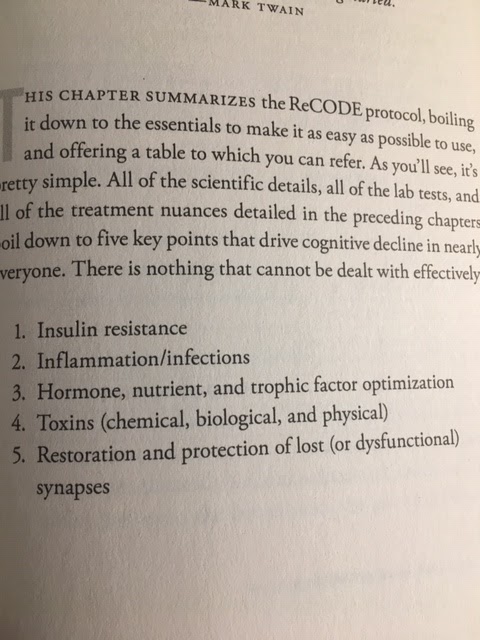
against the mainstream dogma that Alzheimer’s is a single disease characterized by the excess production of amyloid-beta plaques. “Our research on the different biochemical profiles of people with Alzheimer’s has made it clear that these three readily distinguishable subtypes are each driven by different biochemical processes. Each one requires a different treatment. Treating them all the same way is as naïve as treating every infection with the same antibiotic.” (p. 9) Bredesen goes on to explain that these subtypes, identified alone or in combination with each other, are risks for brain function decline: “inflammation/infection, insulin resistance, hormone and supportive nutrient depletion, toxin exposure, and the replacement and protection of lost or dysfunctional brain connections (synapses).” (p. 17) Standard one-size-fits-all treatments are destined to fail in these manifestations of degenerative neurological disease.

One truism that helps me on my quest to better understand issues of health and well-being, particularly in order to be the best caretaker for my mother that I can possibly be, is that the more you know, the more ignorant you feel. I do not want to leave the impression that I have little faith in the medical profession. My life was saved by people at the hospital, who kept careful watch over me for three whole weeks, and by my doctors who followed up with me in the years that followed.
The biggest lesson I learned was to listen to my body, to pay attention, to slow down and rest, to put good wholesome food in my mouth, to find ways to exercise that brought me energy as well as pleasure, and made my body feel better. If that sounds hard, it is. Kind of a lifelong mission actually, but well worth the effort.

Wednesday, January 31, 2018

Guilty Pleasures

Nobody likes to hear more bad news about sugar, but it’s becoming an inescapable fact that sugar and dementia are linked. My cousin, Kathleen DesMaisons, has worked on and published books about the problems associated with sugar addiction for years, and she helps people reduce their dependency and restore their health.  The science behind the connection to Alzheimer’s disease is fairly recent, but the evidence suggests that sugar toxicity causes inflammation and can also lead to insulin resistance, eventually damaging the brain. Dr. Dale Bredesen in his new book, The End of Alzheimer’s   explains:
Sugar is like fire, a source of energy but very dangerous. If you have a fireplace in your home, the amount of wood and the size of fire needed to heat it depends on the size of the house: Less wood/smaller fire if your house is small, more wood/bigger fire if your house is large. Now imagine that you shrink your house by 90 percent, which is essentially what happens when we move less, as is true of sedentary-living Americans: we need less energy. That makes your fireplace effectively ten times as large. If you kept pouring on the wood and stoking the fire, your house would quickly become unbearably hot, the fire might escape from the fireplace, and you would do everything possible to keep your house from burning down. This is the stress most of us are now experiencing. Our bodies recognize sugar as poisonous, and therefore rapidly activate multiple mechanisms to reduce its concentration in our blood and tissues. For one thing, we store the extra energy as fat, which produces brain-damaging factors called adipokines. (p. 49)
In an interview with Dr. Steven Masley, he goes into more detail about the underlying causes of Alzheimer’s and why a tailored approach is required (the whole interview is worthwhile, but the key explanations start at 12 minutes in). The bottom line is we all could benefit from reducing insulin resistance, restoring insulin sensitivity, and reducing glucose levels by drastically lowering our intake of sugar and white refined carbohydrates in order to repair our metabolism and overall health.

That's easier said than done. The reality is we crave our guilty pleasures, especially sweet ones. My mother loves ice cream, and I love dark chocolate; luckily it turns out that cacao is full of polyphenols and is good for you in moderation. Who doesn’t need a little cookie now and then? We are working on the idea of drastic reduction. Our local pasticceria, which has been in business for 56 years and makes
Itty bitty gelato balls
everything on site using high quality ingredients, makes little balls of gelato dipped in dark chocolate. They are the perfect dessert with built-in portion control (and gelato is better than ice cream in terms of calories, fat, and sugar). We also get hazelnuts and candied orange peels dipped in dark chocolate as a treat to have with our post-lunch espresso. Italians make a gluten-free cookie called Brutti Ma Buoni (ugly but good) with hazelnuts and egg whites that we indulge in from time to time. I recently invented a gluten free cookie recipe that we love with oats, raisins, walnuts, and a mashed banana. Here is the recipe (amounts are approximate for about 20 cookies):


Banana Walnut Oatmeal Raisin Cookies

These smell really good while baking.
1 ripe banana
1 egg
3 tbls coconut oil (softened consistency)
¼ cup sugar
½ tsp vanilla
1 tsp baking powder
¼ cup rice flour
2 tbls tapioca flour
½ tsp xanthum gum
Pinch of salt
1 cup organic oats
3 tbls raisins
¼ cup chopped walnuts

Preheat oven to 375 degrees, and use parchment paper on a cookie sheet. Mix the coconut oil and sugar until combined, add the egg and beat until a little frothy. Add the banana and mash with a fork, and add the vanilla. Combine dry ingredients and add to the wet ingredients, mixing in raisins and walnuts when combined. Drop spoonfuls of dough on the cookie sheet and bake for 12-15 minutes until slightly brown on the edges.


Another way to drastically reduce your sugar intake is to indulge in other less harmful guilty
Borini's store window in Rome
pleasures. For us, that means Italian shoes. I recently discovered a store in Via dei Pettinari, Borini, that makes beautiful handmade leather shoes in my size. Let’s just say I got a bit carried away. I cannot resist the comfort of shoes that slide onto my bare feet like soft leather gloves. I can’t bear the ugly look of Crocs when all around me are beautiful Roman women, simply elegant from head to toe. Fortunately, my mother’s favorite brand of Italian shoes, Manas by Lea Foscati, were on sale at the Friday outdoor market, so it all balanced out in the end.

Shoe selfie